
Most of us tend to take things for granted. It is human psychology after all. As long as we see or perceive something to be in abundance, we automatically accord less importance to it. As educated citizens, we do realize the importance of resources but unfortunately the train of thought ends there. Take for example the most common essentials of our daily existence – air, water and land. To my mind these form an equilateral triangle of human life. All three elements are equally important and they contain within their boundaries, the circle of our life.
We all realize the importance of these resources for our survival, but beyond allocating a few minutes of our time in discussing their scarcity; do we really think or do much? Have you ever given a serious thought that if either of these elements is taken away from us how will we survive? Scary notion indeed!
It is a common practice in urban settlements, especially Tier 1 and 2 cities to assume that resources will outlive us. Maybe because we have not seen them getting extinct or because we have not lived in the real India (i.e. villages) long enough to realize what insufficiency actually means. And therein rests my fascination for Suprio Das and Cynthiya Koenig. These individuals have perhaps always lived in urban locales but had the foresight to think of solutions for population at the bottom of the pyramid. They conceptualized products to address problems faced by millions of rural people. The reason I thought of combining their ideas in one write-up is because of their complementing nature. While each idea is powerful in itself, but if there would be a business model that combines both, we could truly see change at a faster pace. The positive impact on health of masses would be amplified. After all, Aristotle famously said ‘The whole is greater than the sum of its parts’.
Suprio Das is the brain behind Zimba – a device that purifies drinking water safely, accurately, economically and at the source itself. His idea was grounded in the simple thought of devising a mechanism that automatically mixes chlorine into water in the correct proportions, regardless of the flow. It can be easily bolted on any existing source, such as hand pump or tap. Since his primary target market is rural population, Das ensured that the product should not require electricity, should have no moving parts to fail and could run on a naturally available and plentiful source i.e. gravity. He also bypassed the need for regular servicing and there are no expensive cartridges to replace. Compared to other large scale water purification systems, a Zimba dispenser can handle thousand of litres of water per day.
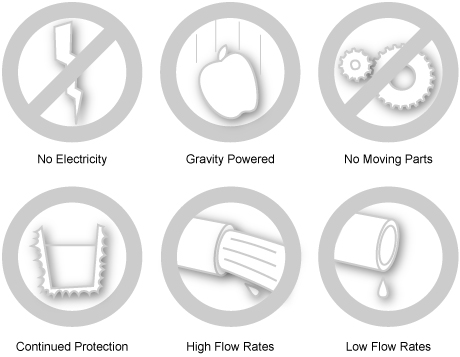
Zimba is a fool proof device that can find applications beyond mass scale water purification. For instance, it could be used as an attachment to overhead water tanks at housing societies to provide water to all connected houses, or in restaurants to purify water used for cooking. Given the low manufacturing cost and easy portability, it can be transported and quickly put in action for relief operations (such as the recent flood relief work at Uttrakhand). Zimba is in fact a boon for temporary erections such as infrastructure projects or real estate developments where large number of workers camp for months.
But what do we do when such large quantities of purified water is made available to communities and villages at one go? For most people clean water comes with the twist of a tap. But for 1 in 6 people, access to water requires meticulous scheduling – waking up at specified hours, walking long distances, queuing up and finally lifting the heavy containers back home. Given that water is heavy and human capacity is limited, transporting water to point of consumption is still a mammoth task. The situation gets complicated because basic human requirement of clean water is at least 5-10 litres per day. This translates into multiple members of a family having to waste productive time in water collection everyday.
That’s where Cynthia Koening’s Wello comes in. The WaterWheel is a simple yet brilliant manifestation of an idea to transport up to 50 litres of water hygienically and without any extra effort. Designed as a plastic roller, it has a unique cap-in-cap design which prevents recontamination at the point of use. Given the fact that water collection and transportation is a task relegated to women, WaterWheel has helped free up their valuable time. By doing so, it has not only made women more productive but indirectly also assisted children in going to school and letting them concentrate on studies.
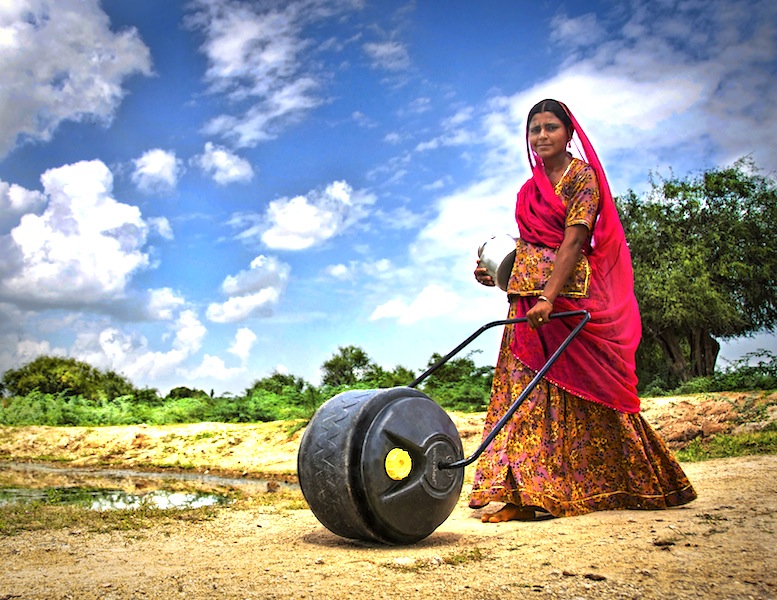
Wello has clearly reinvented the wheel! What’s more, Cynthia has even identified ways to monetize the WaterWheel by offering rolling ‘real estate’ for advertisement space!
Suprio and Cynthia are beacons of social entrepreneurship in India. They have identified points of intervention in the system and developed a sustainable model for social innovation in a creative manner. The potential for revolution that can be brought about by their ideas is miles ahead of charity done by NGOs or CSR initiatives by organizations. By combining the passion of social development with science, professional management, innovation, and efficiently utilized funds, they have set a new benchmark for ‘Change Agents’ of India.
Watch the inspiring videos and product description here:
Suprio Das
http://www.youtube.com/watch?feature=player_embedded&v=pvJVL6ECGLg
Cynthiya Koenig
http://www.youtube.com/watch?feature=player_embedded&v=R3Dn868I8RQ
(Franklin Templeton Investments partnered the TEDxGateway Mumbai in December 2012. This article is my entry for ‘The Idea Caravan Contest’ organized at Indiblogger)