
Circa 2001.
I was almost through college, having pursued the traditional and orthodox Bachelors of Commerce course. Alongside I had also started off with Chartered Accountancy course but was not able to clear the Intermediate examination in the first attempt, so I was a bit disheartened. Parents, as usual, were encouraging me with the words “You always knew this course was tough and demanding. Just dedicate yourself to it completely and you will succeed with flying colors”. Agreed. But what is the motivation? After completing the course, I would be bracketed into a traditional accountant’s job, lacking any creativity and always having to be conservative with figures! Although I was still not very clear about my career, but this just was not the kind of job or life that I had envisioned for myself. However, the next one year went on with the same confusion reigning in my head all the time.
Then suddenly one evening, while driving past a liquor shop, I got an idea to start a pub-cum-restaurant of my own. I would keep my margins low and hence be able to offer alcohol at dirt cheap prices. Coupled with my knowledge about technology, music and a good location, I thought I had a winner at hand. So I formulated a business plan and showed it to my father. Needless to say, it was shot down because I tried to be ‘daring, unorthodox and rebellious’. My friends also laughed at the prospect of starting something on such a grand scale without having a single penny in my pocket or ‘having sufficient experience to start my own business’. Nonetheless, I was convinced that my idea was feasible. Six months later, a pub came up on the same theme and was an instant hit in Delhi. Till date, whenever I drive past that pub, I have mixed feelings of disappointment and victory. Disappointment – because I could not start that venture. Victory – because I was able to foresee the trend in restaurant business at least six months in advance and come up with a workable idea for the same. So what if I was not able to start it, but at least the idea was good enough to make money!
Life moved on and after graduation I got a plum job with a big Consultancy firm. I was earning good money and the job also offered me an ample scope for creativity. However, the entrepreneur in me was still very much alive and I kept making business plans. Many of these did get converted to reality – albeit not by me! The success of these business ideas only further strengthened my belief in myself. I was totally convinced that I have a strong intuition; keen observation sense and the gut feel to sniff potential opportunities. Plus I was able to predict the trends in the environment as well. Maybe I was not a risk taker and hence could not jump into starting my own ventures. Or maybe it was the lack of seed capital that held me back from starting my own business. Whatever be the case, the grouse always remained within me and with time, only intensified further.
Cut to year 2004.
I decided to quit my job and pursue my MBA degree. I researched on a lot of good B-Schools in India and Asia. Looking at it in hindsight, I was not sure what I really wanted from my B-school, but I just wanted to have a different type of business education. I chose to join Asian Institute of Management mainly because of its pedagogy and faculty. At the same time, I was also attracted by the rave reviews that I had heard about the entrepreneurship course at AIM. Frankly, it was my ambition of becoming an ‘educated, skilled and knowledgeable’ entrepreneur that brought me to AIM. However I was still skeptical about the concept of being able to ‘teach’ a subject like entrepreneurship to anyone.
The entrepreneurship course proved to be an eye opening experience. It was because of this course that I had the experience of preparing a live business plan from a venture capitalists’ point of view. It was also because of the course that I got the chance to participate in the Asia Moot Business Plan competition at Bangkok and experience real-life VC presentation. The icing on the cake was the two live funding offers that my team received from VCs! These events not only boosted my morale further, but also rekindled the passion in me to become an entrepreneur. I always was confident of my gut feel, as it has proved to be my guiding light in many difficult situations. But still, my ability to take risks head on, or to completely trust and follow my ‘sixth sense’ had not yet developed.
In order to learn a subject like entrepreneurship, I feel a lot of philosophical discussions and critical introspection needs to happen. Reflecting on my past, present and future probably made me realize that my own enterprise should be in line with my vision for my life. I used to carry certain misconceptions about entrepreneurship. One of the biggest among these was that a business is always a for-profit entity and personal values can take a back seat. However, this has been completely reversed now. I am convinced now that unless the venture is an extension of the entrepreneur himself, it will not succeed and make money. Hence, it is essential to find an idea which I am interested in and which can prove to be a value for the society also. This fit shall ensure success for my business and customer satisfaction as well.
The second wrong notion was about the entrepreneur himself, who is perceived to be a somewhat extraordinary or out-of-this-world personality. Though there have been a few convincing arguments towards this notion, I would still not agree with it totally. I was told that the major factor distinguishing entrepreneurs from other people is their ability to see what others cannot and then trace a pattern about how business trends are going to shape up in the future. Here’s where I disagree. I believe that the ability to trace patterns and to predict trends comes not only from experience and observation, but just by being alert and keeping your own knowledge updated. In some instances, it just happens because the individual is present “at the right place at the right time”.
I can cite my own example here. I have a keen eye for detail, a habit which is often an irritant for my colleagues, since I delve into the details of each and every thing. Additionally, I also like to read a lot on the latest technological developments, entertainment and electronics. This has helped me to envision and develop a lot of patterns myself. Many of them have been put on paper as formal business plans, which I plan to venture out sometime in life. Hence, even though I do not consider myself to be an extraordinary person, but I believe I have the required capabilities to become an entrepreneur.
An entrepreneur has to have the ability to gather data using all the five senses, and most importantly, combining it with his own experience to make ideas work. This thought has stuck on to me and has actually forced me to activate all my senses when I’m in the outside world. Initially, I used to just learn from my eyes (to observe changes in the environment) and ears (to pick up and learn from other people’s experiences). But by being able to experience from all five senses, I have realized that there are a whole lot of new ideas that come to my mind. The best part is that now I can think of multi-purpose products and services, which was previously not possible, maybe because of my limited scope of thinking. From that session, I also truly believe that an entrepreneur necessarily has to be adventurous and daring. It enables him to tread uncharted paths and venture into new and risky areas. This further adds on to his experience, which can be helpful if a similar situation is encountered in the future.
The Complete-Holistic-Individual Model
This model basically breaks up an individual into different components and describes the ideal characteristics that make a person. According to me, an individual’s roots are in his family background and education. With a good family background and sound education, a strong foundation is laid for the future. Hence, these two factors represent the legs of the person in the diagram.
During the formative years of the child, parents instill a set of values and culture system in the child. At the same time, equal emphasis should be laid on developing and maintaining good health. These factors shape up the growth of the individual. Thus, I represent the lower torso with these two ingredients.
When it comes to teenage years and beyond, the individual should start developing a sense of commitment, dedication as well as creativity towards his tasks; be it academics or work. During these years, it is essential for the person to develop a connection with God through religion and also to his own inner self, through spirituality. These are not absolute essentials for success (since I have witnessed many atheist becoming very successful in life) but the presence of these components ensures a faster growth and achievement of goals. Hence, the latter two constitute the arms (or the support function) of the person. All the above four components constitute the upper torso of an individual.
If all the factors are present in an individual, success and goal fulfillment becomes a rather simple journey. Thus the head is represented by these.
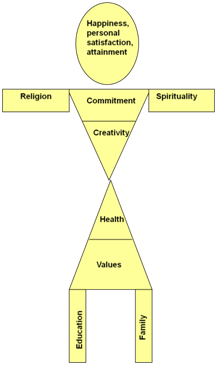
When I relate this model back to the take home value of “keeping the end in mind”, it presents a clear picture of life. If my ultimate goal is materialistic (luxury car, house or lifestyle), it becomes very difficult to include that in the scheme of things, since by nature, human body is not designed to be that way. On the contrary, if attainment of goals and personal gratification is the end goal, everything else flows in order. No doubt, material things are necessary and form an important part of satisfaction, but I discourage the achievement of these as the end goal. At the most, material things should only be peripheral to goal fulfillment.
The essence of my take on entrepreneurship is all about cultivating the habit of reflection, and start by introspecting on my life’s vision, mission and objectives before formulating the same for the business.
Excellent post Nishant. You have rightly said that a successful entrepreneur can see trends and has an eye for detail.
I Really liked the pictorial representation; quite innovative.
Thank you for the comment and appreciation!
The Complete-Holistic-Individual Model is a new concept for me. I can relate it to something I read earlier. Stephen Covey in his 7 habits of highly effective people – proposed that we should look after 4 aspects of life : Physical, Mental, Emotional and Spiritual. I think this model covers all the 4 aspects.
That model is my own creation. Credit for pushing me to come up with it though goes to my MBA Prof. He was adamant that we all devise new frameworks to disrupt existing thinking in manager.